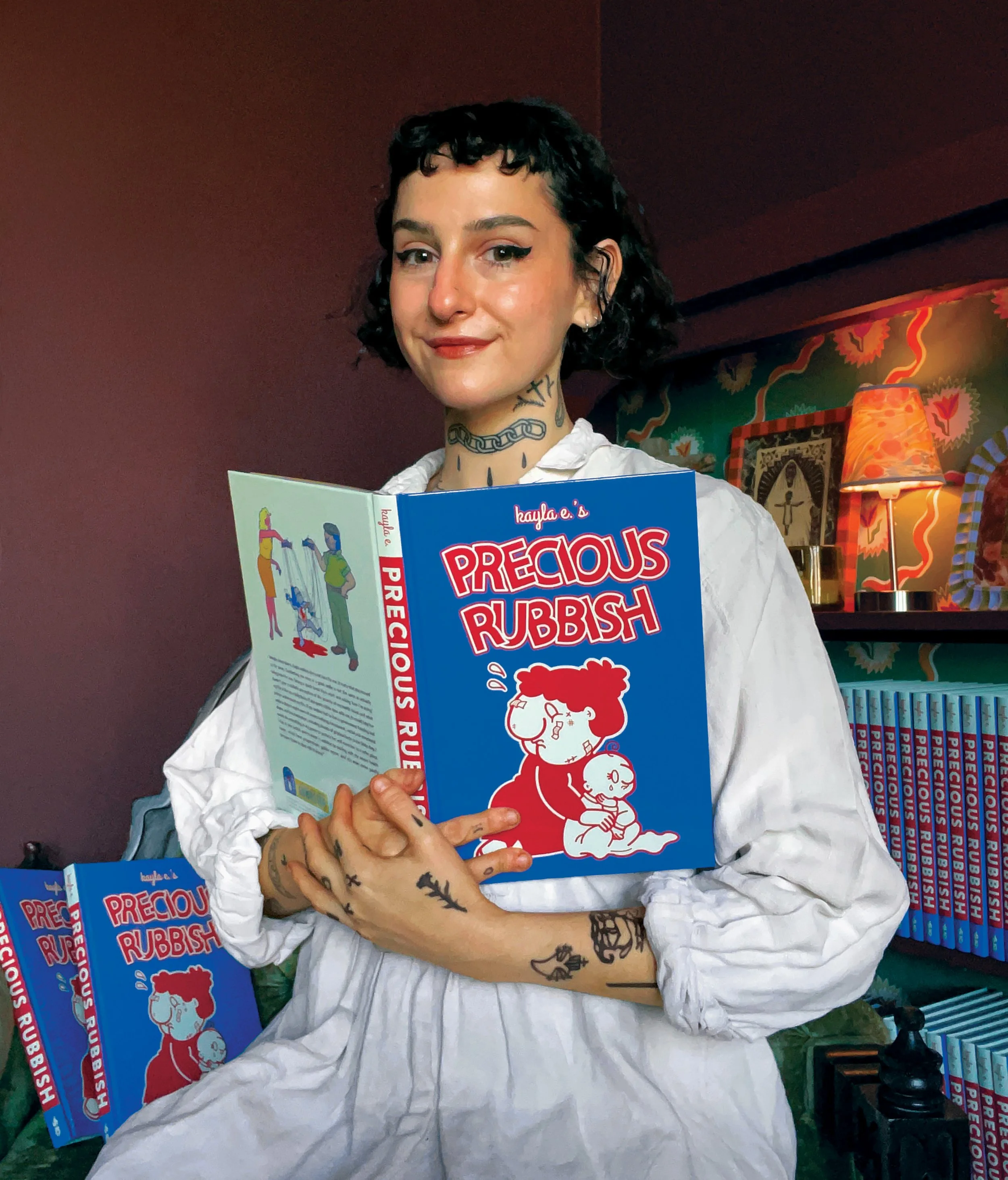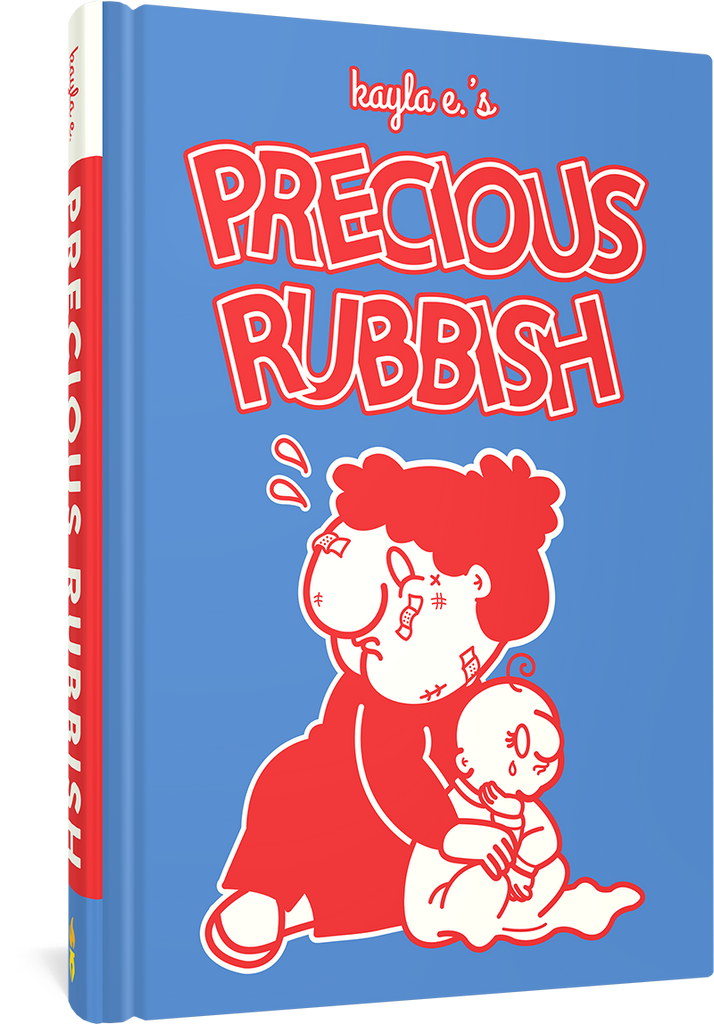
Precious Rubbish
A landmark graphic memoir told in the style of post-war children's comics, tracing a childhood shaped by trauma, poverty, and Pentecostal fanaticism in rural Texas.
📖 Fantagraphics • Started 2025
“If an exorcism can ever be slow and quiet, then every panel I’ve finished has felt something like an exorcism. The gutters give me space to make sense of things: to connect dots and close gaps. To remember.”
Kayla E.’s Precious Rubbish is an experimental graphic memoir drawn in a style that references the aesthetics of mid-century children’s comics—Archie, Little Dot, and their contemporaries—and tells the story of a childhood shaped by maternal emotional dysregulation, rural poverty, and incest. The author’s childhood is portrayed as a collection of short-form comics and gag panels punctuated by interactive elements like paper dolls, satirical advertisements, games, and puzzles.
The book’s protagonist, Li’l Kayla, divides her time between her estranged parents: an unstable, abusive mother and a disinterested father who turns a blind eye to the worst abuse. As she grows up, she grapples with being queer in a fundamentalist Christian environment and begins to abuse alcohol. The story unfolds out of chronological order and filtered through the formats of mass-produced print entertainment—picture books, comic strips, activity pages, paper dolls, recipe cards, comic-book advertisements.
The result is a work that asks the reader to do the extratextual work of filling out narrative gaps, mirroring the challenge of trauma recollection. The reader is invited to co-labor in the meaning-making process, an exercise that facilitates an intimacy—between the author, the subject, and the reader—that is at once horrifying and hilarious. A word search invites readers to find “vodka,” “dissociation,” and “PTSD.” An advertisement reads: “Do You Need Money? Consider robbing your child’s piggy bank!” The playful visual language, drenched in cheery primary colors, contrasts sharply with the harrowing content.
Kayla’s mother appears sometimes as a faceless 1950s housewife engaging in horrifying behavior, sometimes as a huge and terrifying presence, sometimes as a child who needs to be cared for herself. The flawless pastiche of commercial art and design suggests the influence of Chris Ware and Ivan Brunetti while establishing an aesthetic all its own.
Published by Fantagraphics in April 2025, Precious Rubbish won the 2025 Ignatz Award for Outstanding Graphic Novel, received an Honorable Mention in the 2025 International Latino Book Awards, and earned starred reviews from Publishers Weekly and Booklist. The book was named one of the best books of 2025 by the New York Public Library, Booklist, A.V. Club, Literary Hub, and The Guardian. Translations are forthcoming in Spanish and French.
Critics have been unanimous in their praise. “This four-color atomic bomb of a comic signals the arrival of a formidable talent,” wrote Publishers Weekly in a starred review. “Precious Rubbish is a scream as precisely pitched as a middle C from a tuning fork,” declared the New York Times. “Kayla E. uses her medium to striking effect: her wry portrait reveals a fresh eye, at once vulnerable and undaunted,” noted The New Yorker.
Ivan Brunetti, whose own work influenced Kayla’s style, praised it as “a triumph of pure resilience—a psychic thick, dark syrup of personal pain, humiliation, and suffering. And it will make you laugh inappropriately (and guiltily), which is the highest praise I can give.” Chris Ware called it “may help you come to terms with some things you’ve been privately avoiding or even things about yourself you didn’t know.”
The 196-page book is printed on thick high-gloss stock, designed to replicate the gloss of vintage newsstand cover stock—impossibly bright and perfect. It’s a triumph of book design, earned when Kayla was nominated for an Eisner Award for Best Book Design on another Fantagraphics project, the Bill Ward: The Fantagraphics Studio Edition.
Perfect for fans of Chris Ware’s Jimmy Corrigan, Ivan Brunetti’s Schizo, or graphic medicine works like Eula Biss’s “The Pain Scale”—comics that use the formal properties of the medium itself as tools for meaning-making. Readers who appreciate work that transforms the disposable aesthetics of commercial comics into vessels for personal and cultural memory will find Precious Rubbish essential reading.
Created by Kayla E..