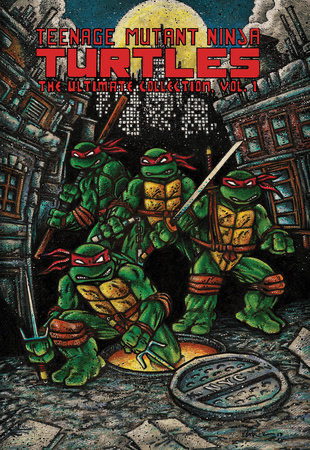
Teenage Mutant Ninja Turtles
The self-published 1984 black-and-white comic that sparked the biggest indie comics phenomenon ever—four mutagenic martial-arts turtles, a rat sensei, and an entire empire.
📖 Mirage Studios • Started 1984
Teenage Mutant Ninja Turtles is the comic that proved self-publishing could topple an industry—the forty-page black-and-white bombshell that two friends printed in 1984 and watched ignite the biggest creator-owned phenomenon comics has ever seen. Perfect for fans of Daredevil, Frank Miller’s Ronin, Cerebus, and the entire 1980s indie comics renaissance, it remains the definitive self-publishing origin story.
The Kitchen Table Birth of an Empire
In May 1984, Kevin Eastman and Peter Laird—two friends who had met in Northampton, Massachusetts—self-published Teenage Mutant Ninja Turtles #1 under the banner of Mirage Studios, a company that existed mostly on kitchen tables and couches with lap boards. The initial print run was just 3,275 copies, funded in large part by a $1,000 loan from Eastman’s uncle Quentin. The book was a loving, low-budget parody of the four most popular comics of the day—Marvel’s Daredevil and New Mutants, Dave Sim’s Cerebus, and Frank Miller’s Ronin—filled with the deep blacks and scratchy energy of underground comix. By September 1985 the first issue was already in its fourth printing, and Eastman told the story of those chaotic early years in depth to The Comics Journal’s Gary Groth in The Kevin Eastman Interview Part I.
The premise was absurd on its face: four turtles mutated by mutagen and trained in ninjutsu by their master, a rat sensei named Splinter, dwelling in the sewers beneath New York City. But Eastman and Laird’s martial-arts melodrama—pitting the turtles against the Foot Clan and their armored arch-nemesis, the Shredder—struck a nerve. When the series debuted, its origin story, its sweeping “Return to New York” and “City at War” arcs, and its rotating cast of guest stars (including a memorable team-up with Cerebus and frequent appearances by Stan Sakai’s wandering rabbit ronin, Miyamoto Usagi, chronicled in Usagi Yojimbo) made Mirage Studios the beating heart of the black-and-white boom.
From Sewers to Superstardom
What followed was a cultural takeover: a 1987 animated series that became a Saturday-morning phenomenon, Playmates action figures, video games, movies, and a merchandising empire that made Eastman and Laird millionaires while the mainstream industry scrambled to catch up. The original Mirage series ran through 1993, and the property would pass through Image and back to Mirage before Eastman returned to the character in a major way at IDW Publishing from 2011 onward—culminating in the acclaimed dark-future epic Teenage Mutant Ninja Turtles: The Last Ronin, a story concept Eastman and Laird had nursed since 1987.
Today, the original black-and-white issue is one of the most sought-after comics of the Copper Age, and the series’ legacy is available in the annotated Teenage Mutant Ninja Turtles: The Ultimate Collection hardcovers from IDW, which collect the Mirage run with commentary from its creators.
Similar in spirit to Cerebus, Love and Rockets, and the whole wave of 1980s alternative comics, Teenage Mutant Ninja Turtles is the proof that a wild idea drawn on a kitchen table can outlast the industry that said it would never work.