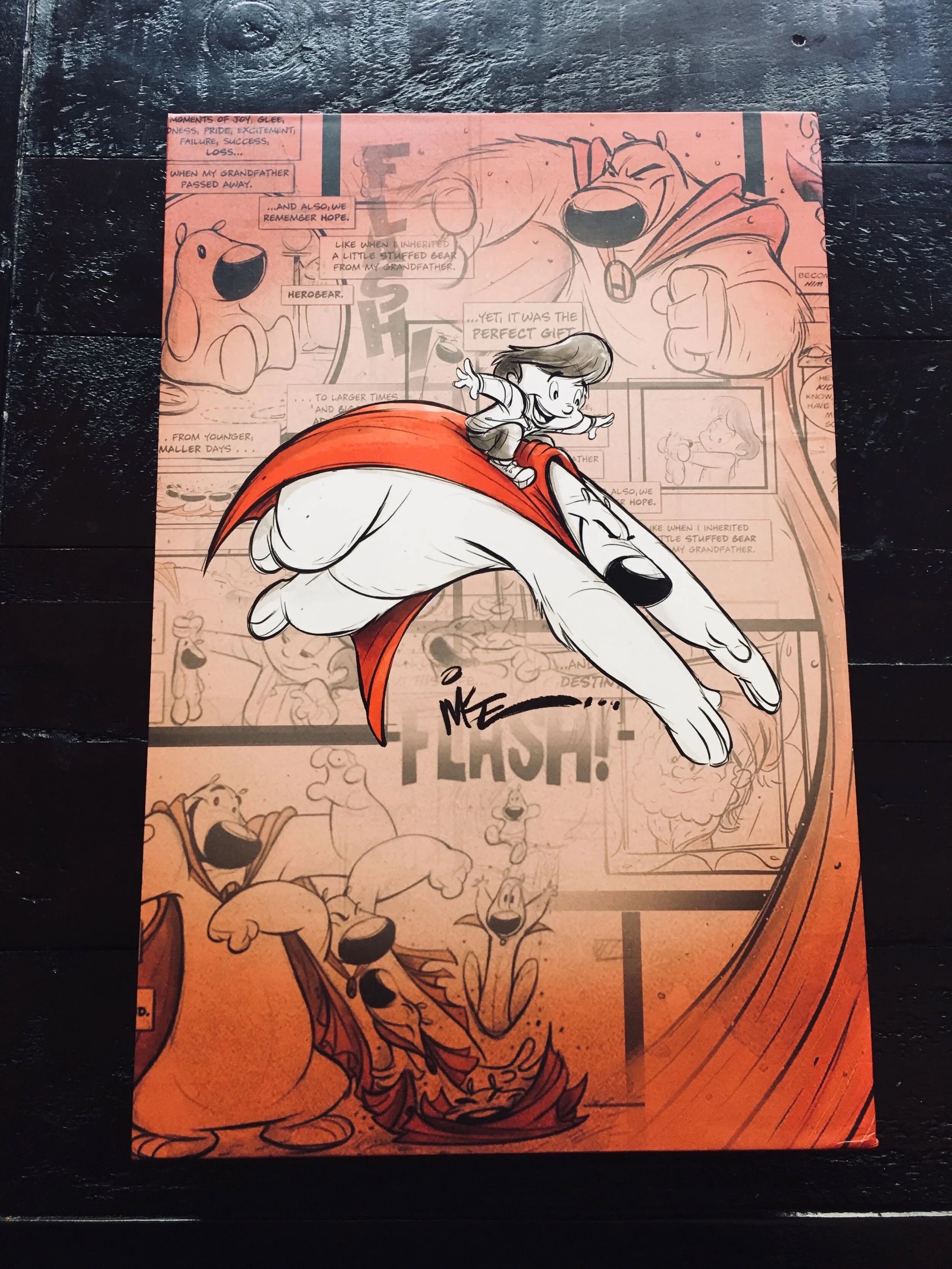
Mike Kunkel
Two-time Eisner Award-winning cartoonist and animator known for Herobear and the Kid, DC's Billy Batson and the Magic of Shazam!, and work on Hercules, Spider-Verse, and The Garfield Movie.
📍 Southern California
Before he was a two-time Eisner winner, before he brought Spider-Verse and Hercules to life, Mike Kunkel was just a ten-year-old kid in Canoga Park, California, who knew exactly what he wanted to be. He declared his career path early, setting up a makeshift studio in his walk-in closet with a hand-drawn sign on the door: his very own “cartoon company.” That childhood spark never flickered out. It grew into a wildfire of a career, propelling him to become one of the most versatile storytellers working at the crossroads of comics and animation—a creator who moves between penciling indie darlings and shaping blockbuster animated features with the same effortless grace.
The Animator’s Journey
Kunkel’s professional animation career ignited in the 1990s, and he wasted no time making his mark at the highest levels of the industry. He animated on Disney Renaissance classics like Hercules (1997) and Tarzan (1999), lent his talents to Warner Bros.’ Cats Don’t Dance, and contributed storyboard art to Sony’s game-changing Spider-Man: Into the Spider-Verse. His character design work for Cartoon Network’s The Life and Times of Juniper Lee won him the Annie Award for Best Character Design in an Animated Television Production—a testament to his gift for infusing personality into every line.
Read his résumé and you’re browsing a highlight reel of modern animation. He served as a story artist on The Garfield Movie (2024), Leo (2023), and Smurfs: The Lost Village; directed episodes of Madagascar: A Little Wild and Kick Buttowski: Suburban Daredevil; and left his fingerprints on beloved series including My Life as a Teenage Robot, Dora the Explorer, and Mickey Mouse Clubhouse. He also designed Swampy, the breakout character from Disney’s smash mobile game Where’s My Water?—proving his ability to create icons whether on screen or on a phone.
Herobear and the Kid
For all his animation pedigree, Kunkel’s heart has always belonged to Herobear and the Kid. The idea first stirred in high school: a young boy named Tyler inherits a stuffed bear and a broken pocket watch from his grandfather, only to discover that pressing the bear’s nose transforms it into a ten-foot-tall, cape-wearing polar bear superhero. It’s a premise that feels both intimately personal and universally magical.
Published by Kunkel’s own Astonish Comics in 1999, the series hit the direct market like a bolt of warmth. Drawn in Kunkel’s signature “animation way”—pencil artwork accented only by Herobear’s striking red cape—the comic stood apart from everything else on the stands. It won the Eisner Award in both 2002 and 2003, a staggering achievement for a self-published indie comic in an industry dominated by the Big Two. Universal Studios took notice, optioning the property for a feature-length animated film; Kunkel co-wrote a screenplay alongside Jeph Loeb.
After a well-earned hiatus, Kunkel revived the series through BOOM! Studios in 2013, releasing new adventures and reprinting the original story for a fresh generation. In 2023, he launched a triumphant Kickstarter for the Herobear Heritage Hardcover—a mammoth 600-page collection that pairs the original “The Inheritance” storyline with an entirely new 250-page sequel, “Saving Time.” The series now lives with Papercutz, distributed by Simon & Schuster, and continues to find new readers who fall in love with its quiet, wondrous heart.
DC’s Shazam and Beyond
Kunkel brought his signature warmth to the DC Universe, writing, drawing, and coloring Billy Batson and the Magic of Shazam!—a joyous relaunch of Captain Marvel for a new generation of young readers. His run paired the character’s mythic scale with the intimate, expressive storytelling that defines all his work, making the magic feel both cosmic and deeply human.
Through his studio The Astonish Factory, Kunkel continues to spin new worlds. He’s created children’s books like Timmy and the Moon Piece, Ham and Eggs, and The Land of Sokmunster, along with instructional art books like The Art of the Squiggle. He also pays it forward as a storyboarding instructor at Animation Mentor, shaping the next wave of animators and cartoonists with the same generosity that defines his art.
Style and Influence
Kunkel’s work sits at a beautiful crossroads: the expressive posing of Chuck Jones, the hand-drawn warmth of mid-century Disney features, and the storytelling economy of newspaper strips like Calvin and Hobbes and Garfield. The result is instantly recognizable—a style that squeezes more personality into a single panel than many artists manage across an entire issue, where every line breathes and every expression lands.
Perfect for fans of all-ages adventure comics in the tradition of Calvin and Hobbes, Jeff Smith’s Bone, and Art Baltazar’s Tiny Titans—stories full of genuine heart, gentle humor, and the kind of warmth that makes you want to revisit your own childhood.