Supermag
A glossy magazine-format anthology exploring "narrative collapse" through genre-hopping comics, illustration, graphic design, and irreverent humor from Eisner-winner Jim Rugg.
📖 AdHouse Books • Started 2013
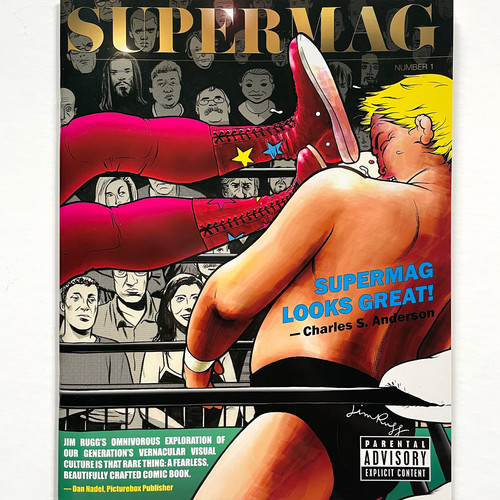
Supermag is Jim Rugg in pure, uncut form—a glossy, magazine-format collection that defies easy categorization the way Rugg himself does. Neither quite a comic nor quite an art book, Supermag is what happens when one of the most inventive cartoonists working today decides to turn the page layouts of an entire magazine into a playground for what he calls “narrative collapse.”
The term, which Rugg borrowed from author Douglas Rushkoff, describes the way modern readers consume media: not in linear narratives from beginning to end, but in fragments. We scroll, we skip, we jump between twenty books at once. Supermag was designed for exactly that mode of engagement. “It’s not designed to necessarily read in one sitting,” Rugg explained to Healthy Artists. “You can pick it up here and there, when you’re looking to kill five minutes in an interesting way. It’s a collection of stand-alone pieces.”
And what pieces they are. Published by AdHouse Books in 2013, Supermag collects Rugg’s best anthology contributions alongside brand-new work, showcasing his restless range across genre illustration, deadpan humor, graphic design, typography, and cartooning. One page features a man confronted by his own doppelgänger in an apartment doorway, illuminated by passing headlights—a complete story in a single panel. Another page channels Vanilla Ice into high art. There’s political commentary, absurdist gags, formal experiments, and the kind of ballpoint-pen drawings that Rugg’s fans have come to treasure.
The book’s production is itself a statement. In an era when print publishing was supposedly in decline, Rugg leaned into the physical object: a full-color, 56-page magazine printed at 8.5” x 11”, priced at $9.95 to keep it accessible. “As print declines commercially speaking, we now have access to printing technology that’s never been more affordable or higher quality,” Rugg noted. “The print medium is becoming more and more of an expressionistic outlet, rather than a commercial one.” A limited European edition of 33 copies, bound in hardcover with a dust jacket, was also released for collectors.
Supermag captures a pivotal moment in Rugg’s evolution—the point where a master of pastiche began turning his eye toward the medium itself, asking what a comic could be when freed from the obligation of linear storytelling. It’s essential reading for anyone interested in the intersection of comics, graphic design, and the fractured attention spans of the 21st century.
Perfect for fans of Chris Ware’s formal playfulness, the anthology experiments of Kramer’s Ergot, and anyone who’s ever picked up a magazine and found themselves lost somewhere between the articles.