Chris Weston
British artist behind The Filth and War Stories — a master of photo-realistic detail across 2000 AD, Vertigo, and Avatar Press.
Chris Weston is one of the most meticulous craftsmen in British comics — an artist whose obsessively detailed, photo-real style renders everything from the chrome-and-concrete sprawl of Judge Dredd’s Mega-City One to the deranged secret agents of Grant Morrison’s The Filth with the same forensic precision. His pages carry the legacy of his mentor Don Lawrence, the master of clean-line realism behind Storm and The Trigan Empire, and of inker Gary Erskine, whose razor-sharp linework Weston’s drawings were made to meet. Perfect for fans of Lawrence’s documentary-style realism, Erskine’s controlled hatching, and war comics that sweat every rivet and shell casing.
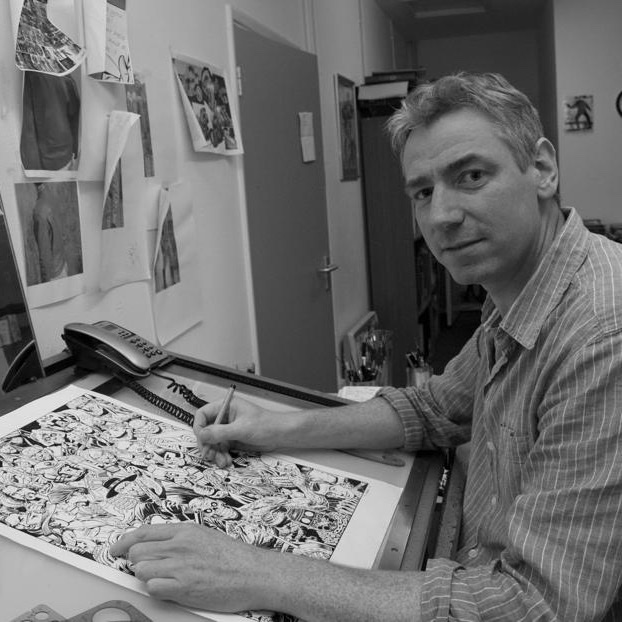
Born in West Germany to a British family and raised across several countries before settling in England, Weston began his professional career as a teenager, apprenticed for a year to Don Lawrence before landing his first paid job — on Judge Dredd in the pages of 2000 AD in 1988. He cut his teeth across the Galaxy’s Greatest Comic with writer John Smith on Indigo Prime’s grim, time-travelling “Killing Time” and with Mark Millar on Canon Fodder, establishing himself as one of the anthology’s most reliable draftsmen. It was a 2000 AD interview he later gave that laid out his working method: traditional hand-drawn pencils, scanned and coloured digitally, with every page built on obsessive reference research.
Millar brought Weston to America, where his first US work was a Swamp Thing issue for Vertigo, followed by turns on The Invisibles, Starman, Lucifer, The Authority, and Time Breakers — and, in 2002, the collaboration that cemented his reputation: The Filth, the thirteen-issue, creator-owned Vertigo maxiseries written by Grant Morrison. Conceived at a San Diego dinner as the pair’s shared attempt to “create the weirdest comic ever,” The Filth asked Weston to draw prosthetic-outfitted dolphins, communist killer chimps, and a giant severed hand harvesting ink — and his deadpan, photo-real execution made the insanity feel perfectly plausible. He followed it with Ministry of Space, Warren Ellis’s “what if” tale of a Britain that wins the Space Race, and later drew Marvel’s The Twelve with J. Michael Straczynski, while becoming one of comics’ most sought-after cover artists.
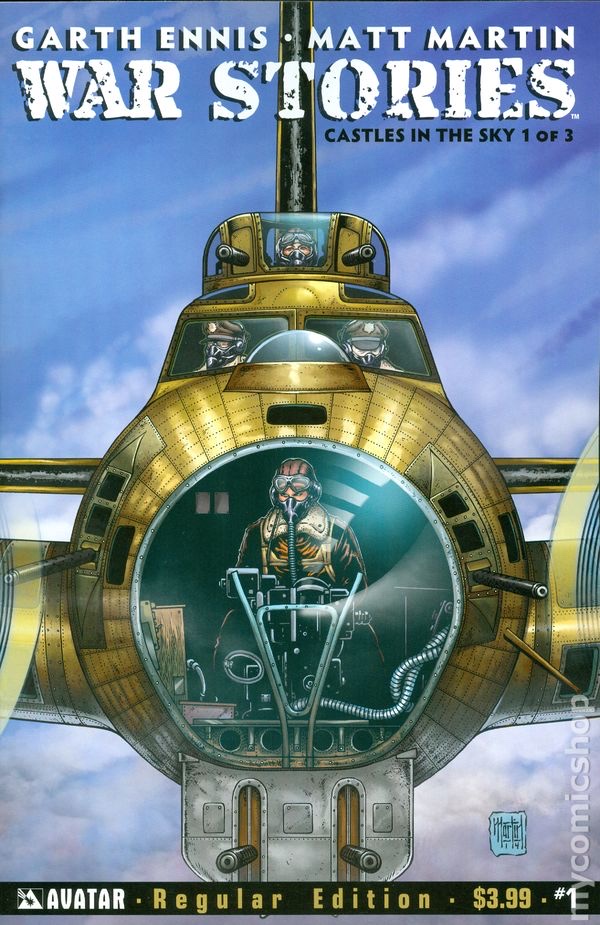
War is where his meticulousness shines brightest. Weston teamed with Garth Ennis on Enemy Ace: War in Heaven and then on the tank saga Johann’s Tiger, originally a 2001 Vertigo one-shot now collected in the Avatar Press volumes of War Stories. The story follows a German Tiger tank crew fleeing west through the dying Reich, and Weston’s research-heavy art gives every gear, medal and mud-caked uniform an eyewitness weight — critics noted that while his layouts echo the lionising war comics of old, he and Erskine’s details capture “all the horrors.” Wikipedia documents the full arc of his career from Judge Dredd to the present day, and Lambiek’s Comiclopedia likewise traces his path from Lawrence’s studio to Vertigo.
Beyond comics, Weston has spent years as a film and TV concept artist — storyboarding The Book of Eli and the unmade live-action Akira for Albert Hughes, and working as a costume designer on Star Wars: The Last Jedi — while continuing to draw Judge Dredd for 2000 AD and producing a growing line of silkscreen print commissions. His latest art, commissions, and screenprints live at The Art of Chris Weston, and he can be followed on Twitter/X and Bluesky. Few artists can claim to have drawn the strangest comics of their era with this much straight-faced conviction — and fewer still make you believe every impossible panel of it.